Hanson Center Visiting Scholar 2026-2027: Dr. Mary C. Murphy
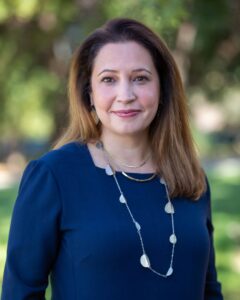 The Hanson Center is excited to announce that Dr. Mary C. Murphy will be the 2026–27 Hanson Center Visiting Scholar.
Dr. Murphy is an internationally recognized scholar in advancing diversity, equity, and inclusion, and the Herman B. Wells Endowed Professor of Psychological and Brain Sciences at Indiana University. She is also the founding director of the Summer Institute on Diversity at Stanford University’s Center for Advanced Study in the Behavioral Sciences and the founder and CEO of the Equity Accelerator—a research and consulting organization that partners with colleges and other organizations to build equitable learning and working environments.
The author of more than 100 publications, Dr. Murphy was awarded the 2019 Presidential Early Career Award for Scientists and Engineers, the highest award bestowed on early career scholars by the U.S. government. She is also an elected fellow of the American Association for the Advancement of Science.
Dr. Murphy will visit Lafayette College on the following dates:
- Thursday, October 22 – Friday, October 23, 2026 (in-person)
- Wednesday, February 24, 2027 (virtual)
More details about the schedule below.
About Dr. Murphy
Mary C. Murphy is a social psychologist whose research shows that mindsets are not just individual beliefs; they are also shaped by classrooms, workplaces, and organizational cultures. These local cultures can either promote learning, collaboration, and inclusion or reinforce threat, fixed ability beliefs, and inequality. Her work spans growth mindset, stereotype threat, belonging, identity threat, and the social cues that shape motivation and performance, especially in STEM fields and other settings.
Building on the high-impact engagement of Dr. Nilanjana “Buju” Dasgupta’s visit as the 2025-26 Hanson Center Visiting Scholar, we look forward to Dr. Murphy’s residency reinforcing and extending the work launched last year.
Fall Semester Inclusive STEM Reading Group: Cultures of Growth
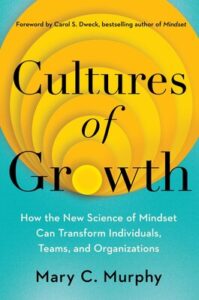 Dr. Murphy’s book, Cultures of Growth: How the New Science of Mindset Can Transform Individuals, Teams, and Organizations, will be the Fall 2026 Inclusive STEM Reading Group selection. The book provides research-informed insights for building environments where all individuals, no matter their social identities and backgrounds, thrive. The Inclusive STEM Reading Group is open to all members of the campus community.
If you are interested in participating, please complete this form by 5:00 p.m. on Friday, September 4.
2026-27 Schedule
Thursday, October 22 – Friday, October 23, 2026
- “Cultures of Growth: How the New Science of Mindset Can Transform Individuals, Teams, and Organizations”
Campus-Wide Presentation
Thursday, Oct. 22, 4:15-5:30 PM, Kirby 104 - “Classrooms of Growth: Growth Mindset Cultures that Spur Student Success”
Interactive Workshop
Friday, Oct. 23, 11:45 AM – 1:00 PM, Wilson Room, Pfenning Alumni Center
Register here by Tuesday, October 20th at 5:00 PM.
Wednesday, February 24, 2027
- Virtual Presentation & Discussion: 4:15 p.m. – 6:00 p.m.
More About Dr. Murphy:
Dr. Murphy’s early and influential work helped show how situational cues can trigger stereotype threat for women in math, science, and engineering settings, with implications for participation and performance. She later extended this line of research to show that organizational and classroom environments communicate whether ability is seen as fixed or improvable, shaping trust, motivation, and persistence.
Expanding on these findings, Dr. Murphy’s research examines how organizational mindsets and environmental cues interact with social identities, including race, gender, and first-generation status. She studies how a “culture of growth”—where intelligence and skills are seen as characteristics that can be developed and nurtured—positively impacts motivation, performance, and belonging. Conversely, her work demonstrates that fixed mindsets, along with stereotypes of “brilliance” that favor dominant groups, create barriers in STEM and other fields, particularly for historically marginalized groups. By bridging data-driven science with practical interventions, Dr. Murphy offers actionable insights for fostering equitable environments across all departments, programs, and roles.
Her groundbreaking work has secured over $12 million in federal and foundation funding, including a recent $2.2 million NSF CAREER award. Dr. Murphy’s scholarship has been widely covered by major media outlets such as The New York Times, Forbes, Harvard Business Review, Scientific American, and NPR and she has been featured in podcasts and video sessions by PBS, Bloomberg, Hidden Brain and other programs.
Dr. Murphy earned a B.A. from the University of Texas at Austin and her PhD in social psychology from Stanford University in 2007, where she was mentored by Claude Steele and Carol Dweck. She completed a NSF postdoctoral fellowship at Northwestern University. In 2012, she joined the faculty of Indiana University and, in 2013, was named a Rising Star by the Association for Psychological Science (APS).
Selected Publications
Murphy, M. C. (2024). Cultures of Growth: How the New Science of Mindset Can Transform Individuals, Teams, and Organizations. Simon and Schuster.
Canning, E. A., LaCosse, J., Kroeper, K. M., & Murphy, M. C. (2020). Feeling like an imposter: The effect of perceived classroom competition on the daily pschological experiences of first-generation college students. Social Psychological and Personality Science, 11(5), 647–657. Read
Canning, E. A., Muenks, K., Green, D. J., & Murphy, M. C. (2019). STEM faculty who believe ability is fixed have larger racial achievement gaps and inspire less student motivation in their classes. Science Advances, 5(2), eaau4734. Read
Canning, E. A., Murphy, M. C., Emerson, K. T. U., Chatman, J. A., Dweck, C. S., & Kray, L. J. (2020). Cultures of genius at work: Organizational mindsets predict cultural norms, trust, and commitment. Personality and Social Psychology Bulletin, 46(4), 626–642 . Read
LaCosse, J., Murphy, M. C., Garcia, J. A., & Zirkel, S. (2021). The role of STEM professors’ mindset beliefs on students’ anticipated psychological experiences and course interest. Journal of Educational Psychology, 113(5), 949–963. Read
Muenks, K., Canning, E. A., LaCosse, J., Green, D. J., Zirkel, S., Garcia, J. A., & Murphy, M. C. (2020). Students’ perceptions of their STEM professors’ mindset beliefs predict their psychological vulnerability, engagement, and course interest. Journal of Experimental Psychology: General, 149(11), 2119–2135. Read
Murphy, M. C., & Dweck, C. S. (2010). A culture of genius: How an organization’s lay theory shapes people’s cognition, affect, and behavior. Personality and Social Psychology Bulletin, 36(3), 283–296. Read
Murphy, M. C., & Zirkel, S. (2015). Race and belonging in school: How anticipated and experienced belonging affect choice, persistence, and performance. Teachers College Record, 117(12), 1–40. Read
Murphy, M. C., Steele, C. M., & Gross, J. J. (2007). Signaling threat: How situational cues affect women in math, science, and engineering settings. Psychological Science, 18(10), 879–885. Read
Murphy, M.C. & Walton, G.M. (2013). From prejudiced people to prejudiced places: A social-contextual approach to prejudice. In Stangor, C. & Crandall, C. (Eds.). Frontiers in Social Psychology Series: Stereotyping and Prejudice. Psychology Press: New York, NY. Read