Woven Together: Braiding Indigenous and Western Sciences for Shared Solutions to Environmental Challenges
In Spring 2026, the Hanson Center will host a semester of programming focused on Indigenizing STEM. Through speakers, a documentary screening, and campus conversations, we’ll explore how Indigenous and Western scientific traditions can be braided together to address urgent global challenges, such as environmental sustainability, land stewardship, and climate change. This series highlights Indigenous knowledge systems not as alternatives, but as essential to building more just, ethical, and ecologically grounded approaches to science and engineering. At the same time, it offers space to reflect on the historical impacts of colonization on scientific knowledge and whose voices have been included—or excluded. The series will conclude with a community event to plant native crops on ancestral land at LaFarm and send them to the Delaware Nation in Oklahoma, symbolically returning native foods to their original stewards and cultural traditions.
Woven Together invites the campus community to imagine a future where diverse ways of knowing inform collaborative, innovative solutions rooted in reciprocity and responsibility.
Special Thanks
The Hanson Center gratefully acknowledges support of this series from the following co-sponsors: Indigenous Studies Program, Engineering Studies Program, Film and Media Studies Program, and the Engineering Division. Special thanks to Dr. Kyle Keeler (Environmental Studies) and Dr. Andrea Smith (Anthropology and Sociology; Chair of the Indigenous Studies Program) for their invaluable contributions to the program development.
Inclusive STEM Reading Group
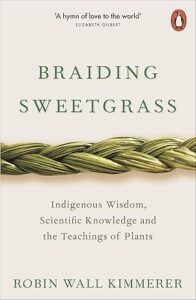
As part of the spring semester’s programming the Inclusive STEM Reading Group will be reading Braiding Sweetgrass: Indigenous Wisdom, Scientific Knowledge and the Teachings of Plants by Dr. Robin Wall Kimmerer. Dr. Kimmerer (Distinguished Teaching Professor and Director, Center for Native Peoples and the Environment, SUNY-Syracuse) will be visiting us for a hybrid Q&A event on Thursday, April 2 at 4:15. Prior to the event Dr. Kimmerer’s video The Fortress, the River and the Garden: A New Metaphor for Knowledge Symbiosis will be available for viewing from Thursday, March 26–Friday, April 3.
Please let us know you are interested in participating in the Inclusive STEM Reading Group by completing this form by 5:00 p.m. on Friday, January 30.
FEBRUARY 2026
Braided Storytelling as a Method in Archaeology: Reimagining Sugpiaq Pasts and Futures Through Story
Dr. Hollis Miller
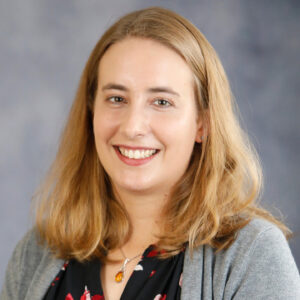
Dr. Hollis K. Miller ‘15, State University of New York, Cortland
Tuesday, February 17, 2026
4:15 PM – 5:30 PM
OCGE 107
This lecture will explore various storytelling methods in archaeology, as situated within a community-based project in Old Harbor, Alaska, a Sugpiaq village in the Kodiak Archipelago. Different methods of storytelling have a place in the practice of archaeology, from the initial formation of a research question to the sharing of results with community members and heritage professionals. Within this community-based research project, it is crucial that the results and interpretations are legible to the Old Harbor community. Here, I review existing information from historical accounts and archaeology to construct story models that generate predictions for new archaeological research into the Russian colonial period at the Ing’yuq Village site. I then braid these story models together with an imagined narrative by Allison Pestrikoff about the Sugpiaq experience of initial Russian arrival in their homelands and artistic interpretations of the Ing’yuq site by Tamara Swenson. Taken together, these different storytelling strategies create a more nuanced picture of Sugpiaq lifeways at Ing’yuq – a picture that includes the historical, emotional, and experiential context of relations to this specific place on the land. I will conclude by discussing how storytelling is an important factor in imagining Sugpiaq futures in Old Harbor.
MARCH 2026
Kincentric Media Ecologies: Indigenous Women, Ancestral Knowledge and Technology in the Andes
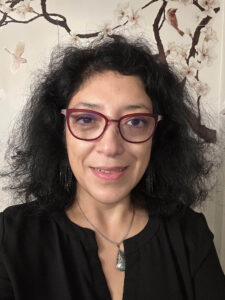
Dr. Carmen Valdivia
Dr. Carmen Valdivia, Assistant Professor of Spanish
Tuesday, March 10th, 2026
4:15 PM – 5:30 PM
Simon Center 300
Indigenous women in the Andes cultivate an embodied relationship with their natural, social, and spiritual territories—categories that do not always align with Indigenous ontologies—in which humans and the more-than-human cohabit and collaborate as kin. This relationality shapes not only their collective and individual political struggles, everyday survivance, and practices of joy, but also the ways they see, use, and produce media. In other words, Indigenous women’s media ecologies cannot be understood apart from their kincentric modes of being. This presentation examines the work of social media content producers Solischa and Alessandra Yupanqui, two Quechua women who mobilize and adapt media technologies to foreground ancestral knowledge and science for new Indigenous generations. Their work also envisions alternative relations with media, proposing new terrains of media sovereignty.
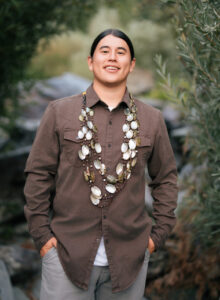
Ryan Reed
Empowering the Next Generation of Fire Leaders
Mr. Ryan Reed, Co-founder and Program Director, FireGeneration Collaborative
Tuesday, March 24, 2026
4:15 PM – 5:30 PM
Simon 109
Wildfires, fire seasons, and community impacts have intensified, and will continue to in future decades due to mismanagement, climate change, and colonial systems that criminalize Indigenous burning. In this talk, Ryan Reed will speak on the Traditional practices of the Karuk people in the Klamath River Basin while touching on the settler colonial disruptions of Indigenous management. Driven by these dynamics, he co-founded FireGen to empower marginalized communities of the next generation. The organization prioritizes Indigenous leadership by engaging in beneficial fire policy, education, organizing, and research.
The Fortress, the River and the Garden: A New Metaphor for Knowledge Symbiosis
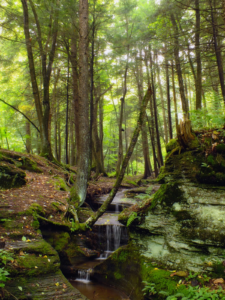
Video (48 minutes)
Thursday, March 26, 2026
4:15 PM – 5:30 PM
Oechsle 224
Available online from March 27-April 3
Prepare to engage with one of the world’s leading voices on ecology, environmental ethics, and the intertwining of Indigenous and Western scientific thinking by watching Dr. Robin Wall Kimmerer’s video presentation, “The Fortress, the River, and the Garden: A New Metaphor for Knowledge Symbiosis.”
This film examines the relationship between three metaphors for types of knowledge. The Fortress is the metaphor for the dominance of western science and its virtual erasure of indigenous knowledge, the River refers to indigenous models of autonomy and coexistence between western and indigenous knowledge, and the Garden examines the potential for a productive symbiosis between western and indigenous knowledges which could grow together in complementarity.
Following the video, we’ll discuss Dr. Kimmerer’s ideas and develop questions for our live hybrid Q&A with her one week later on April 2 (see below).This is your chance to help shape the conversation with a thinker who has addressed the United Nations on “Healing Our Relationship with Nature.”
APRIL 2026
Discussion with Dr. Robin Wall Kimmerer: Hybrid Q&A
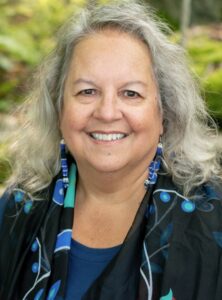
Dr. Robin Wall Kimmerer
Thursday, April 2, 2026
4:15 PM – 5:00 PM
Live audience in Oechsle 224
Zoom registration for virtual attendance
Submit questions for Q&A
Video (available March 27-April 3; see above description)
Join us online or in-person for a Q&A with renowned author and scientist Dr. Robin Wall Kimmerer, who will be joining us virtually to discuss her video presentation The Fortress, the River and the Garden: A New Metaphor for Knowledge Symbiosis. An enrolled member of the Citizen Potawatomi Nation, Dr. Kimmerer is a SUNY Distinguished Professor and founder of the Center for Native Peoples and the Environment at SUNY, Syracuse. Her work is a powerful synthesis of two distinct ways of knowing, striving to utilize the wisdom of both indigenous and scientific knowledge for our shared goals of sustainability and reciprocity.
Dr. Kimmerer is celebrated for her profound and eloquent writing, most famously in her book, Braiding Sweetgrass: Indigenous Wisdom, Scientific Knowledge and the Teachings of Plants. Her writing challenges readers to consider ecological restoration not only of natural communities, but of our fundamental relationship to the land. This essential message earned her the prestigious MacArthur Fellowship in 2022 and led her to address the General Assembly of the United Nations on the topic of “Healing Our Relationship with Nature.” This is a unique opportunity to engage directly with one of the world’s leading voices on ecology, ethics, and cultural heritage.
Land Acts: Land’s Agency and Environmental Justice in Literature, Law, and History in the Native Northeast
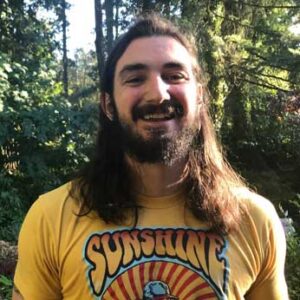
Dr. Kyle Keeler
Dr. Kyle Keeler, Assistant Professor of Environmental Studies
Tuesday, April 14, 2026
4:15 PM – 5:30 PM
OCGE 107
This talk traces land’s agency across Mohegan and Haudenosaunee narratives, and compares the Indigenous relationships therein to land’s commodification in colonial legislation and literature. Professor Kyle Keeler explains how land structures Haudenosaunee and Mohegan legislation and society in creation story and law, and he offers how land’s agency appears and is contorted into foundational colonial legislation in the Mason Land Case of the seventeenth and eighteenth centuries. Native recognition of land’s agency and its influence on Native writing and legislation is representative of “Literature of Landed Resistance,” a framework for understanding how Native authors situate their relationship to and understanding of land to resist settler confinement and removal. Understanding land as a member of society and legislator centers land throughout American history and shows land’s role as an agent and an influence in community- and nation-building.
In understanding land and Native thought as foundational to U.S. legal precedent through “literature of landed resistance,” contemporary Supreme Court cases utilizing the philosophy of the Mason Case must be reexamined, because land has influenced centuries of U.S. legal history and structured contemporary law, and Native sovereignties must come to be seen as stronger than previously recognized by the courts. We must see, and accept, land as an acting member of society, especially as it pertains to Native thought, Native writing, and colonial histories that continue to harm human/nonhuman relations, and Native sovereignties and land’s agency in cultural and legal production come to be seen as non-negotiable.
MAY 2026
The Harvest of Heritage: Sending Native Crops from LaFarm to the Delaware Nation
Saturday, May 16, 2026
LaFarm
9:00 AM – 12:00 PM
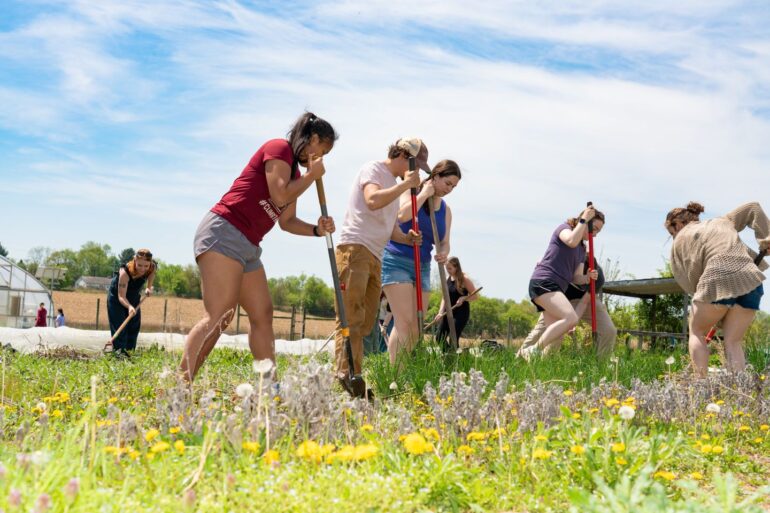
We will conclude our semester with a community event to plant native crops on ancestral land at LaFarm and send them to the Delaware Nation in Oklahoma, symbolically returning native foods to their original stewards and cultural traditions. We will gather at LaFarm to plant native crops on ancestral land, tending to the same soil used by Indigenous peoples for generations. Once harvested, these native foods will be sent to the Delaware Nation in Oklahoma, completing a powerful journey.
Come join us to learn about Indigenous agricultural heritage, and be a part of this living connection between the land, our community, and the Delaware Nation. All are welcome—from beginners to experienced gardeners—to participate in this essential act of stewardship and celebration.